10 Years Running Meta Ads. Here's What Actually Matters.
· Articles
Phil here, Director of Paid Social. I've been running Meta ads for over 10 years. I've managed accounts spending a few hundred pounds a month and accounts spending hundreds of thousands. I've watched the platform change so many times that the playbook I used in my first year is almost unrecognisable from the one I use today.
But some things don't change. The fundamentals that determined whether an account succeeded in 2015 are the same ones that determine it now. They just show up differently.
This is what ten years actually taught me.
Creative quality beats everything
Your account structure can't save bad ads. Your targeting can't save bad ads. Your bid strategy can't save bad ads.
I said this a year ago and it's still the truest thing I know about Meta:
The reason creative matters more now than it ever has is that Meta's algorithm, post-Andromeda, uses your creative as the primary targeting signal. Your ads tell the system who to show them to. Weak creative doesn't just fail to convert. It fails to find the right people in the first place.
This is also why a lot of brands attributed their performance decline to Andromeda when the real problem was simpler than that.
Lorenzo Pravata Quote Retweet (Everything you need to know about andromeda to scale Meta)
If your creative isn't stopping the scroll, nothing downstream matters.
Account structure is the second variable
Most accounts are silently sabotaging their own creative performance through fragmented campaigns, over-segmented ad sets, and too many ads competing for the same limited budget.
The fix isn't complicated, but it requires letting go of the idea that more control equals better results. Giving the algorithm more consolidation, fewer ad sets, more ads in each, broader targeting, consistently outperforms the tightly segmented setups most people default to.
One change that comes up more often than any other in account audits: brands separating testing and scaling into different campaigns when there's no reason to. Launch new creative directly into live ad sets. Scale it in situ. Stop moving winners around and breaking their learning.
Exclusions matter more than targeting
Stop trying to tell Meta who to target. Start telling it who not to target.
Purchasers, your email list, high-intent site visitors, exclude them all and let the algorithm find everyone else. This is one of the most consistently overlooked levers in paid social. Most accounts I audit have at least one significant exclusion gap.
The reason it matters isn't just efficiency. Poor exclusion hygiene drives up frequency with people who have already bought or are already in your funnel. That pushes CPMr up, and rising CPMr is the earliest sign that an account has a problem.
Net new reach is your leading indicator
If your net new reach is declining as a percentage of total reach, Meta is struggling to find efficiency with new audiences. That's the warning sign. Not ROAS. Not CPA. Those are lagging indicators, they move after the damage is done.
This is what you don't want to see in your weekly dashboard:
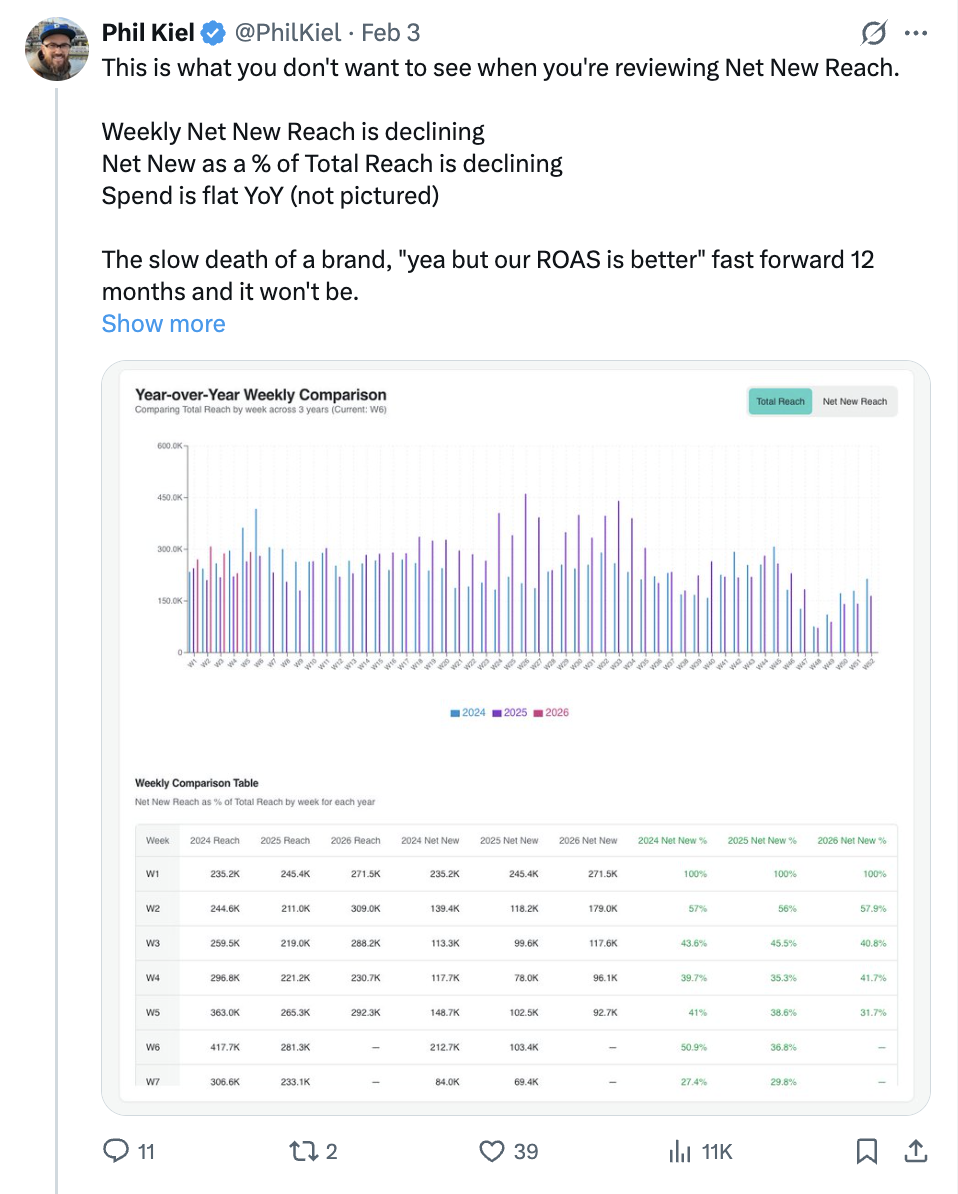
70% net new reach is roughly the sweet spot to aim for. When it starts dropping below that week on week, something in the account needs attention before the headline metrics reflect it.
The relationship between net new reach and CPMr is direct. When new reach falls, CPMr rises, because the algorithm is spending more to re-serve ads to the same people. Track both together.
David Herrmann Quote Retweet (GEM from Meta in action)
Testing velocity beats testing volume
Brands that launch eight to twelve genuinely different concepts per month consistently outperform brands that launch forty variations of the same concept.
This took me years to fully accept, because volume feels productive. More ads, more tests, more chances to find a winner. But Meta's algorithm doesn't treat near-identical ads as separate tests. It treats them as the same creative. You're not generating more signal. You're generating more noise.
Conceptual diversity is the thing that matters. Different problem angles, different formats, different emotional territories. Creative win rate, the percentage of ads you launch that actually go on to win, tells you more about your creative process than any volume metric.
A win rate below 10% usually means you're testing too many small variations. Above 20% usually means you're not testing enough genuinely different territory. The 10 to 20% range is where healthy creative output tends to sit.
The rest is noise
Platform updates. New features. Beta access. AI tools. Rep recommendations. Attribution changes. Every week there's something new to pay attention to and most of it doesn't move the needle.
I'm not saying ignore the platform. You need to understand how it works and when things change. But none of it matters if your creative is weak and your structure is broken. Fix those two things first, then optimise the details.
Ten years in, I still spend more time thinking about creative than anything else. That hasn't changed since day one.
If your account isn't growing, let's look at why.
We work with ecommerce brands spending$100k+ a month on Meta who want to scale without the inefficiency. If CPMr is climbing, net new reach is falling, or your creative isn't winning, those are solvable problems.
Book a 15-minute discovery call and we'll tell you exactly what we'd focus on first