Bothism... Everybody Knows. Nobody Does.
· Articles
Jake here, Director of Growth & Partnerships.
Brand and performance. Chandeliers and lasers. Long-term and short-term.
Bothism.
The idea that the best marketers don't pick a side, they master both at once.
It's a good idea. It's the right idea.
And most growth teams already know it.
That's the problem.
Nobody at a director level or above for a$50M+ brand is sitting in 2026 saying "we only need performance marketing."
They know. They've always known.
The problem isn't conviction. It isn't even measurement.
It's that knowing and doing are two completely different things.
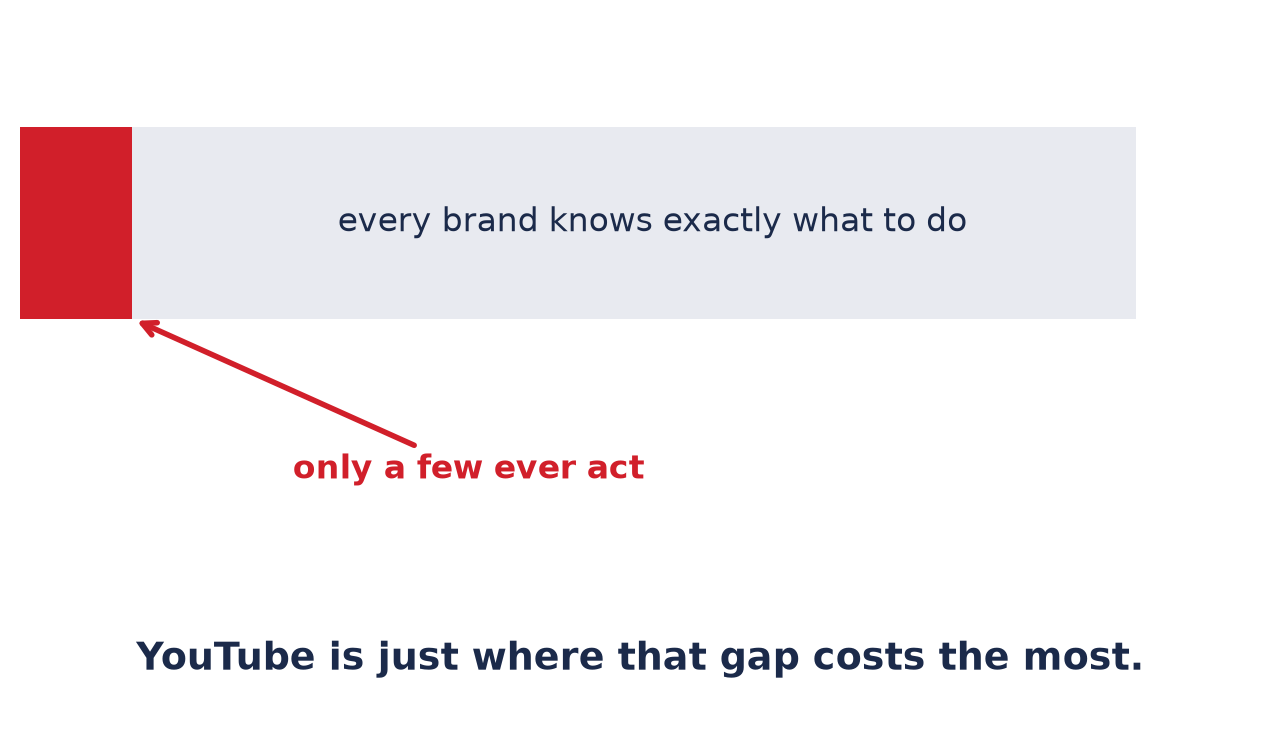
The gap between knowing and doing is the problem.
YouTube is just where that gap costs the most. The upside is too large and too consistently untouched to keep nodding along.
YouTube is Doing Something Most Ignore
YouTube is a brand channel and a performance channel. At the same time. At a level most channels can't match.
Most recent measurement studies show that YouTube drives 72% of incremental conversions from new customers. That alone should make it a serious performance channel.
But it's also responsible for 41% of awareness, 24% of consideration, and 35% of purchase intent. (Source: Nielsen / Measured)
One platform. Every stage of the funnel. At the same time.
Bothism in its most literal form.
The chandelier and the laser built into a single channel (more on that later).
But here's the number that should stop every growth team cold.
YouTube's true lift is underreported by Google's own platform metrics by an average of 35%. For 1 in 4 advertisers, that number is over 400%.
And that's before you account for what happens offline.
I've tracked a YouTube ad view to a transaction at Target Store #312 in California. Not a modelled correlation. An actual connected path.
Connected retail infrastructure... retail media networks, loyalty data, clean room partnerships, makes offline attribution more possible right now than most brands realise.
The channel is always working harder than you think, further down the funnel than you're measuring, and all the way to the shelf.
And teams keep cutting the budget anyway. Or just flat out avoiding it.
For some it's because of the dashboard and not knowing what data exists or what to look at.
For others, you are mastering your key channel first (nothing wrong with that).
For most, that want to scale, it's because acting on it requires doing something uncomfortable.
Running incrementality tests. Extending measurement windows.
Defending brand spend in a quarterly review without a clean ROAS this second.
So they don't. They nod along. And the cycle repeats.
The Airbnb Story Everyone Gets Wrong
The biggest misconception about Airbnb's famous shift away from performance marketing is that they went 100% brand.
They didn't.
They became more balanced. And Brian Chesky's framing of why is still the clearest I've come across. I've already referenced it.
"Performance marketing is a laser. It can light up a corner of a room. You don't want to use a bunch of lasers to light up an entire room. You should use a chandelier. And that's what brand marketing is."
Every marketer who hears that nods along.
Then goes back to running retargeting campaigns.
Chesky drew a line most teams have been unwilling to act on.
You're renting attention. The moment you stop paying, the light goes out. The advantage erodes the second a competitor outbids you.
Brand marketing is investment. It accumulates. It compounds. It builds something that keeps working when you're not actively spending.
Two years after Airbnb made the call, they reported their most profitable fourth quarter on record. They generated over $500 million in profit.
Their CFO noted that 90% of traffic remains direct or unpaid.
Most companies do brand marketing that's about the app, or performance marketing that chases the conversion.
Neither actually educates people about what makes the product different.
YouTube is the most powerful educational medium available to brands right now. Long enough to tell a real story. Targeted enough to reach the right people.
Its contextual engine is one of the most underused levers on the platform... place creative against specific content categories, channels, even individual videos.
Someone watching high-intent cooking content isn't a broad audience. They're in a purchase-adjacent mindset, in a format long enough to actually tell a story. AKA relevance at the top of the funnel.
YouTube has the power to make your brand a noun or a verb.
The ROI on that doesn't show up in week four though... Get comfortable.
The Data Has Been Sitting Here
Google'sEffectiveness Equation report, built from hundreds of studies in partnership with Nielsen, Kantar, Ekimetrics and WARC, put a number on the optimal mix.
For e-commerce brands, media effectiveness peaks when brand building accounts for 40 to 60% of total media investment.
Not 80%. Not 20%. Right in the middle. Precisely where most brands aren't.
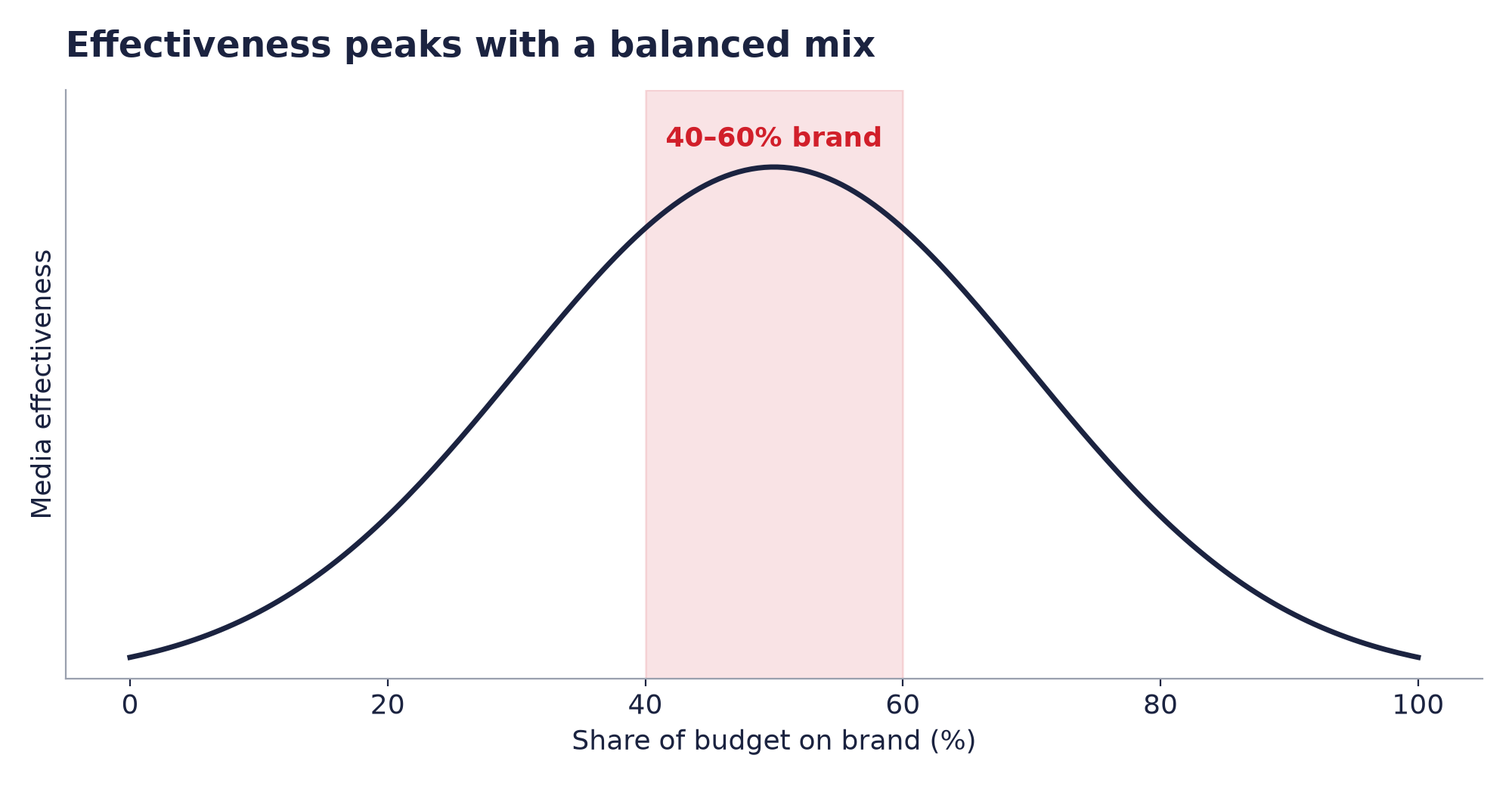
This isn't new information. Teams read it, agree with it, and then allocate 85% to performance because it's easier to defend in a quarterly review.
Brands that pair reach and view-optimized YouTube with conversion-optimized campaigns, and plan investment 6 or more weeks ahead of key seasonal moments, see the most consistent returns.
The planning part alone is something most teams skip entirely.
A 1% lift in brand awareness correlates with a 0.6% lift in long-term sales and a 0.4% lift in short-term sales.
The chandelier is working in the dark, long after the campaign ended.
Teams keep switching it off because they can't see it in attribution.
The Cycle
Here's what actually happens.
A team runs YouTube brand activity for a quarter. Awareness campaigns. Upper funnel video. Content that educates rather than converts.
It doesn't show up in the dashboard.
Finance sees spend without a clear conversion line.
A conversation happens later.
The budget shifts back toward business as usual.
YouTube gets demoted from a brand channel to a bottom-funnel tool.
Six months later, someone pitches Bothism at an offsite.
The room nods.
And the cycle repeats.
This isn't a strategy failure.
It's a willingness failure dressed up as a measurement failure.
YouTube returns in months 5 through 24 are roughly equal to returns in the first four months. Cutting spend to save $1 costs $1.85 to recover.
The data is all there.
It has been there.
The question was never whether you had access to it.
Just Suck Less
I was at Huckberry when I attended a Measured event. Sat front row. And I heard Abhishek Kaushik say one line that cut through everything.
He looked out at a room full of marketers who'd been nodding along to intro slides about MMMs, incrementality testing, multi-touch attribution, media mix optimization, carryover effects, and all the rest of it.
And he said, "Everything I'm about to cover is really just about sucking less."
The room laughed. Then went quiet.
Because he wasn't talking about infrastructure.
He was talking about honesty.
We dress this up in methodology.
We make MMMs and incrementality feel like a PhD program you need to complete before you're allowed to make good decisions.
And in doing so, we give teams a perfect excuse to keep doing exactly what they've been doing.
You don't need a perfect MMM on day one. You don't need a fully triangulated incrementality framework before you invest in brand on YouTube.
There are three things you can do today inside Google Ads Manager that will show you more of YouTube's true impact than most teams ever look at.
But that's not even the point.
The point is honesty.
About the gap between what you know and what you're actually doing.
Close it by one notch. Because you want to get better.
I built my career helping other marketers and brands.
I genuinely want you to get better. Whether we work together or not.
And while we're being honest, let's touch on creative. With YouTube, the creative itself is usually where teams are most willing to be lazy.
You can build a sophisticated measurement stack. Extended attribution windows. Incrementality experiments. Brand health trackers. And then spend two million dollars in media behind a creative that never stood a chance.
It's entirely preventable.
Test creative before you spend on media.
Brand lift predictions before a single dollar goes out the door. Tools like HMM exist precisely for this. And if you want to go deeper, there are AI workflows I use, trained on consumer data, ad libraries, and contextual signals that can take it even further.
Measurement looks backwards. Creative pre-testing looks forward.
Three Honest Questions
Are you actually tracking carryover effects, or just saying you should?
If your measurement window closes at ninety days, YouTube's long-term contribution is invisible. You know this. The question is whether you've done anything about it.
Do you have an MMM or incrementality experiments running, or just attribution?
Attribution will always undervalue brand. You know this too. You need a triangulated view: MMM for the long-term picture, incrementality experiments as the gold standard, attribution for day-to-day signals. Without that triangle you're navigating with one eye closed.
Are you pre-testing YouTube creative before you spend media behind it?
Most teams spend more time in internal reviews than getting real audience data. One pre-test. That's the gap between shipping creative built to perform and hoping for the best.
You don't have to solve all three at once.
Pick one.
Actually do it.
Suck a little less.
The Only Reason to Invest In Brand
The reason you invest in brand on YouTube is to make more money.
Not awards. Not culture. Not feeling good about the work.
More money.
Over a longer time horizon than your current dashboard is measuring.
In most categories, only around 5% of your customers are ready to buy right now. Performance marketing converts that 5%. Brand marketing primes the other 95% to think of you first when they are.
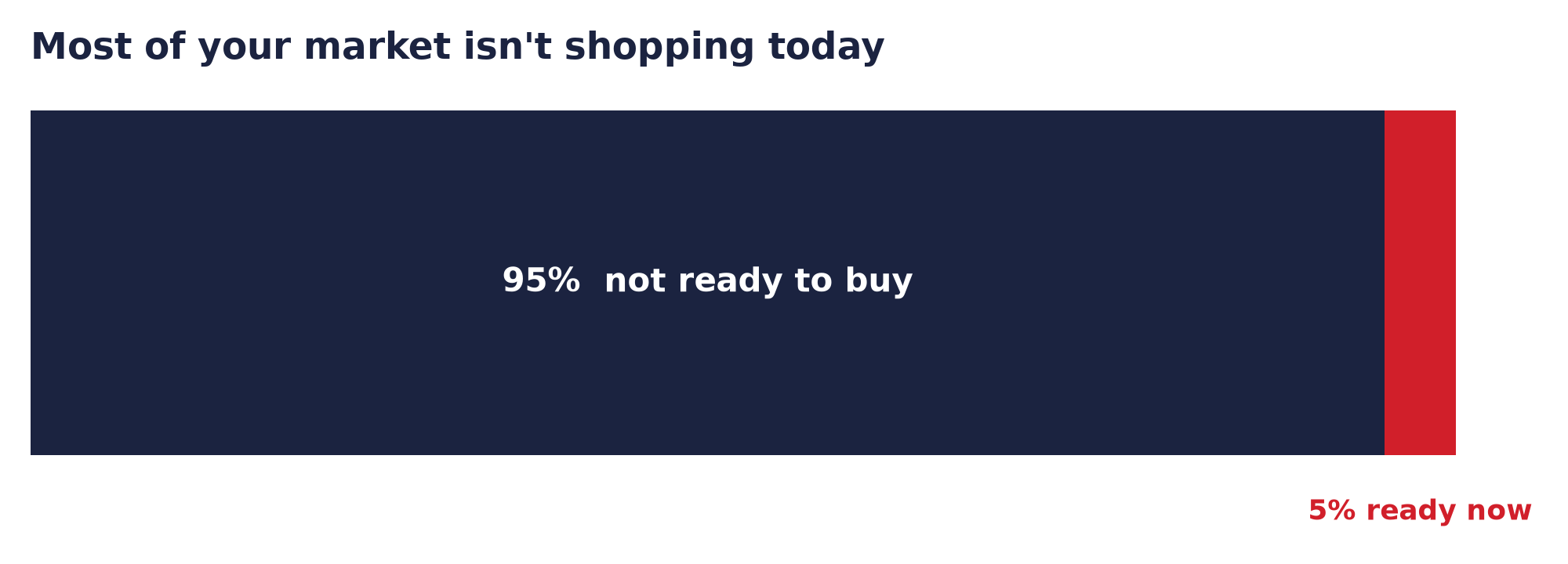
Focusing only on the 5% is a constant, costly battle for a sliver of the market. You know this. The question is whether you're doing anything about it.
YouTube is the only channel that lets you do both at scale.
Reach the 95% who aren't ready yet.
Convert the 5% who are.
Build brand equity that makes both jobs easier over time.
The teams doing this well aren't smarter.
They just looked at the data that we've all had for years, stopped nodding and started doing.
Your unlock will be acting on what you already know.
You've Read This Far
Maybe it was the 400% underreporting stat. Maybe it was the $1.85. Maybe it was just the slow recognition that the cycle needs to break.
Most brands we audit are using YouTube as a retargeting tool or an awareness afterthought.
The ones treating it as the full-funnel growth engine it actually is are pulling ahead quietly while everyone else fights over the same bottom-funnel inventory. Especially within CPG.
The decision to stop nodding is the difference.
If you want to talk through what that actually looks like for your brand in 2026, I'm opening my calendar for a few YouTube specific conversations this month.
Channel strategy, measurement architecture, creative approach. Let's put together a real growth plan for the most under-leveraged channel available right now.
No pitch deck. Just a real conversation.
Book a call with me.