If Your Agency Never Pushes Back, You're Paying for a Task Rabbit
· General
A quiet red flag in PPC is when you never feel a little tension.
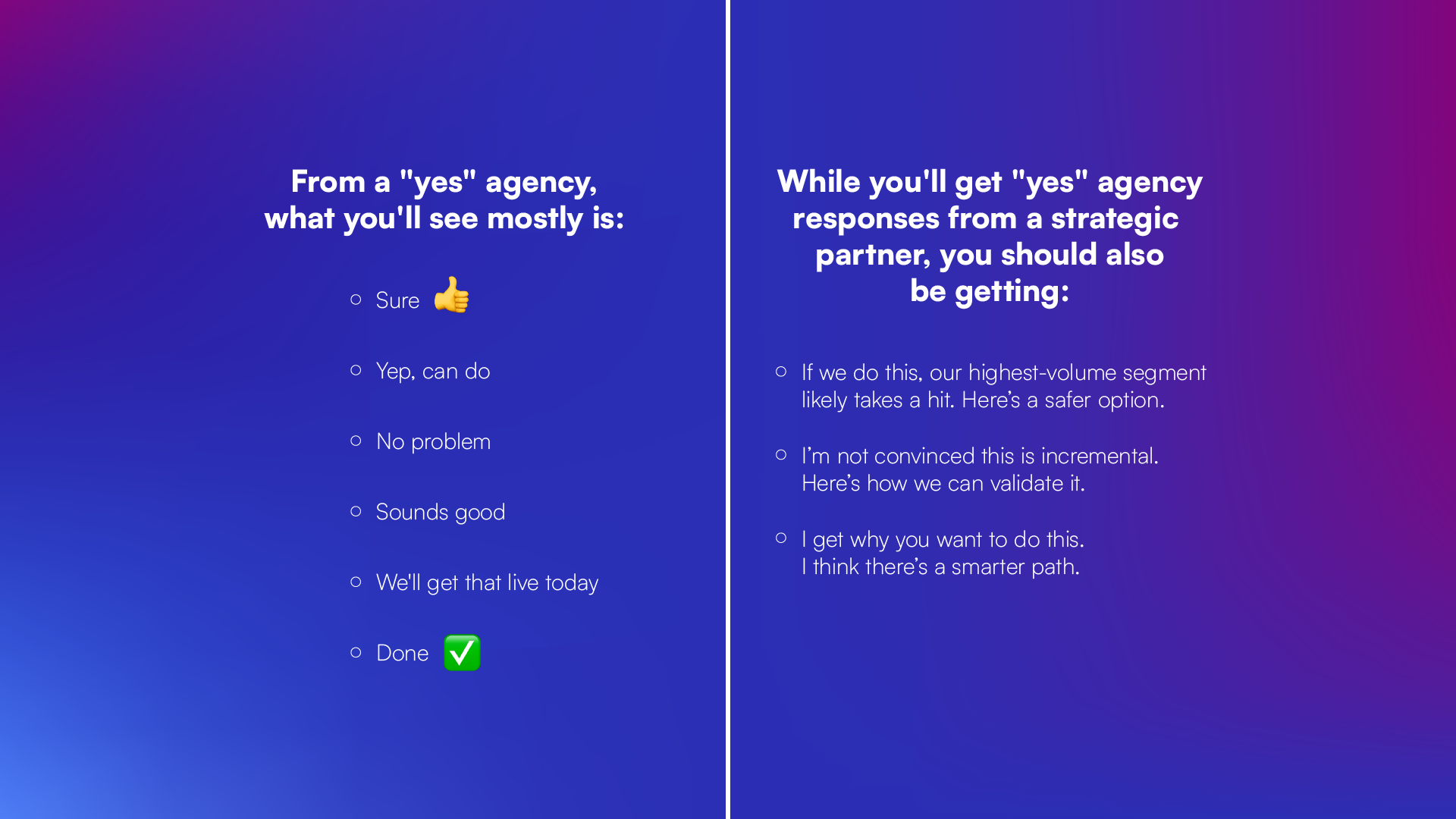
Everything is agreeable. Every request gets a quick, “yes, of course we can do that.” Every idea becomes a task. The work gets done, but nothing gets challenged.
That might sound like a dream. But in performance marketing, zero pushback usually means one of two things: your agency does not understand the business well enough to take a stance, or they are avoiding risk to keep the relationship smooth.
Either way, you should be nervous.
Growth is built on tradeoffs. Tradeoffs require judgment.
If your PPC agency only executes what you ask for, you are not paying for strategy. You are paying for a task rabbit.
Why This Happens, and Why it Feels Good at First
A “yes” agency is easy to work with. Promo push? It’s live. Want to spend more? Budgets go up. Want to test new ad copy? It’s in motion. I’ve been on the agency side of Google Ads for 12 years, and I’d be lying if I said I never found comfort in being this type of account manager.
The catch is that if the relationship stops there, where the client leads and the agency implements, it gets very easy to stay busy and still not move the business forward.
The catch is that if the relationship stops there, where the client leads and the agency implements, it gets very easy to stay busy and still not move the business forward.
And that’s exactly why it feels good at first. The speed feels like partnership. The responsiveness feels like you’re taken care of. But it doesn’t guarantee you have someone willing to tell you when the plan is wrong.
When you’re spending $50K to $500K+ per month, the biggest risk is not that your agency misses a button or forgets a negative keyword. The biggest risk is that everyone stays busy inside the account while the business keeps making decisions off a strategy that is built for stability instead of scale.
The Hidden Cost of a Task Rabbit Agency
Task rabbit agencies create momentum that looks like progress.
You get account activity and a steady stream of "optimizations" that don't add up to a meaningful change in the thing you actually care about: acquiring more customers sustainably. I've learned this the hard way over the years. At one agency I worked at, the #1 reason clients churned was painfully consistent: 'not strategic enough.'
Here's what that looks like in real life:
- ROAS stays healthy, but new customer volume is flat
- Spend increases, but efficiency collapses the moment you try to scale
- Brand and Shopping carry the account while non-brand search stays constrained
- The account becomes dependent on re-marketing, returning customers, bottom funnel intent
- Creative testing slows because "what's working is working"
- Every month feels like a rerun of last month The agency is executing.
The agency is executing. The account is maintained. The business is stuck.

What a Real Growth Partner Does Differently
A great PPC partner isn't there to take orders. They're there to help you make better decisions, faster. The value is in the pushback and the hard calls that keep you from spending the next quarter optimizing the wrong thing. Here are the four areas where that matters most.
1) They challenge the goal
Most accounts are failing because the target is fuzzy, or the target is built for efficiency when the business is asking for growth. You'll hear it when a brand says it wants more customers, but every decision is judged by blended ROAS. Or when "scale" is the goal, but the account is managed like the only acceptable outcome is stability. A strong partner forces alignment by asking:
- What are we optimizing for right now: profit, payback, or scale?
- Is the priority net new customers or total revenue?
- What's the acceptable trade if we want more volume: higher CAC, lower ROAS, longer payback, lower margin?
- What does "winning" look like three months from now, not this week?
Without this conversation, you end up optimizing toward whatever looks safest in a report instead of what the business actually needs next.
2) They challenge the measurement
It's really easy to take platform ROAS at face value. It's also how teams end up overconfident and stuck. A strategic partner digs into where performance can look better than it actually is, especially when the results are coming from places that are convenient to track and uncomfortable to question:
- Brand demand you already earned through other channels
- Re-marketing that "converts" people who were already on their way back
- Returning customer revenue hiding inside a "great" blended number
- Attribution that over-credits whoever shows up last
They ask questions like:
- How much of this is branded and bottom funnel intent?
- What would still happen if we pulled back in a few regions for a short window?
- Are we mixing up incremental with attributable?
- Are we feeding the algorithm real signal, or just the easiest conversions to collect?
Because the most expensive mistake in paid media is scaling what looks efficient on paper, then realizing later it wasn't actually creating new demand.
3) They challenge the inputs
A lot of agencies stay inside the ad account because it's clean and controllable. The problem is that growth usually gets capped outside of it. Once spend is meaningful, the limit is rarely "we need more optimizations." It's the inputs:
- Creative volume and quality (and a real testing cadence)
- Landing pages that match intent
- Offer strength and positioning
- Email capture and follow up
- Merchandising and product mix
- First party signal quality
A good partner will push on these because they've seen the pattern: you can't bid your way out of the weak fundamentals. If your agency never asks for anything outside of your Google Ads, you're not getting a thorough strategy.
4) They challenge the plan
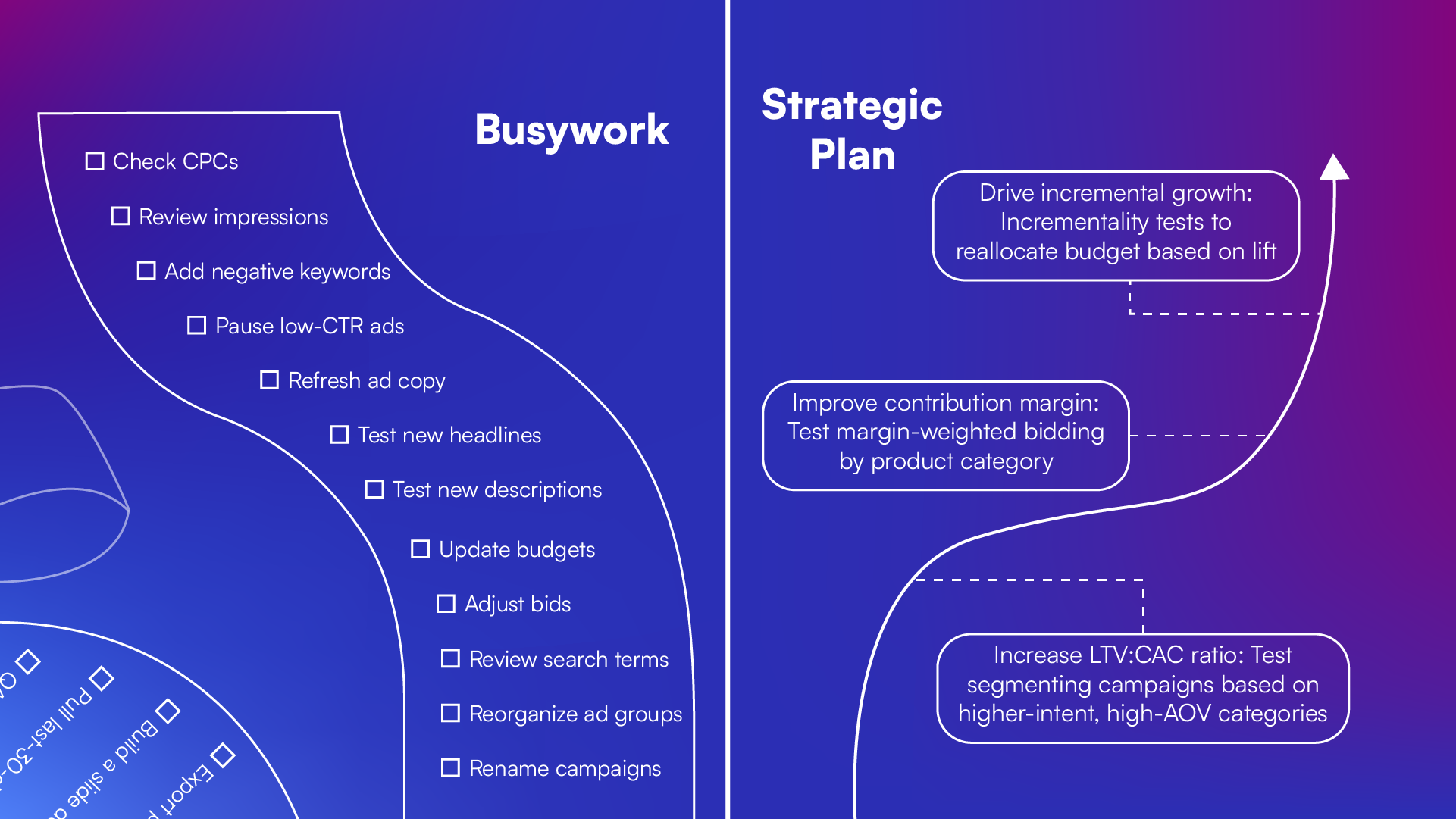
Most PPC roadmaps are a pile of tasks. The best ones are a small set of bets that can actually change the outcome. A strategic partner makes sure you're not "testing" forever. Each month should have at least one focused experiment where everyone agrees on what you're trying to learn and what decision it will unlock.
A good plan includes:
- What we think will happen, and why
- How we'll measure it (based on funnel stage)
- What we'll do if it works, and what we'll do if it doesn't
- Enough budget and time to make the result meaningful
- What we're pausing so this actually gets executed
Task rabbit agencies add more tasks. Strong partners cut the noise, narrow the plan, and make the calls that move things forward.
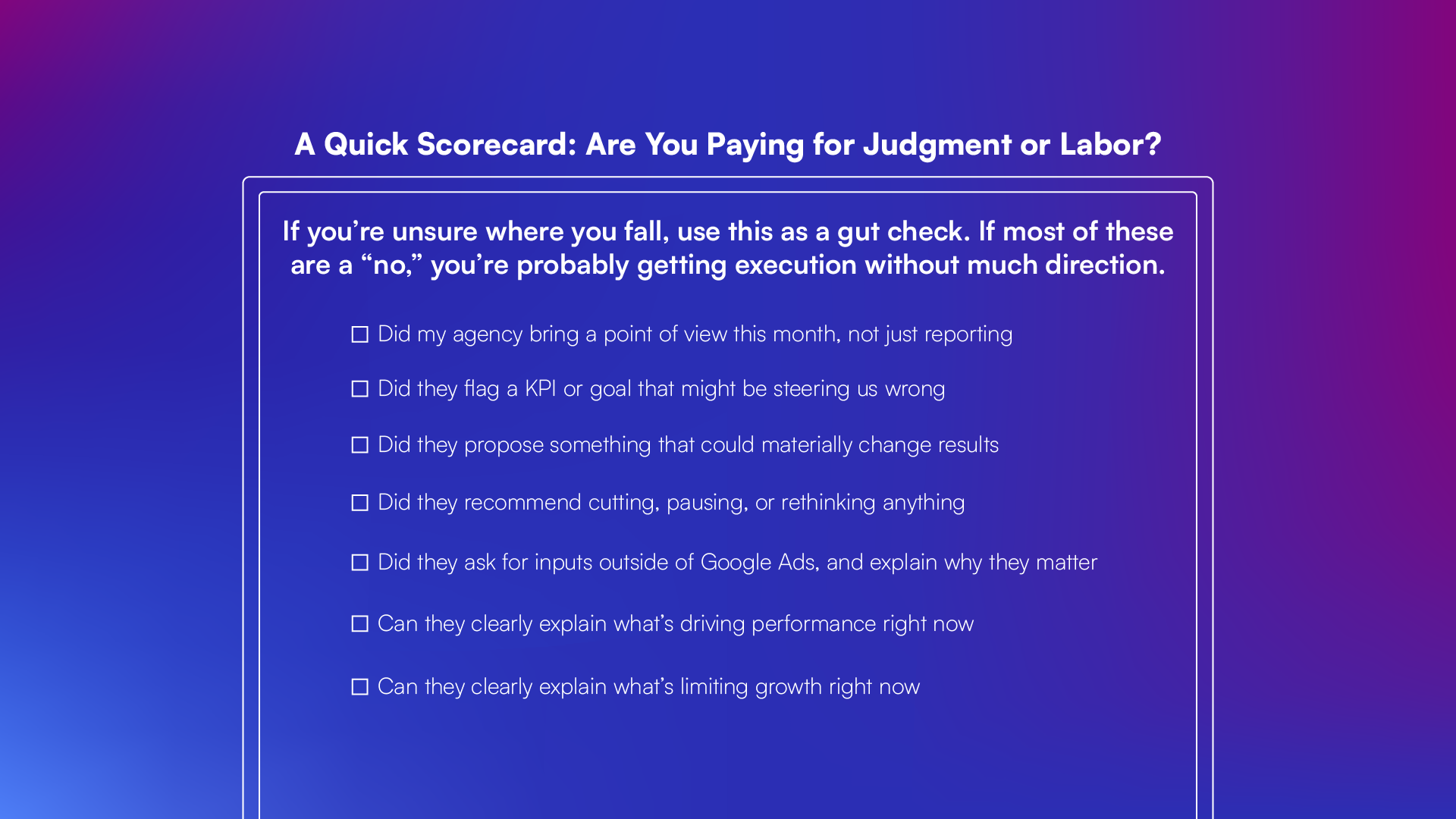
A Quick Scorecard: Are You Paying for Judgment or Labor?
If you're unsure where you fall, use this as a gut check. If most of these are a "no", you're probably getting execution without much direction.
Sometimes the Agency Isn't the Problem
This part matters.
A lot of leaders say they want a strategic partner, then accidentally create a setup where nobody wants to challenge anything.
It usually happens when:
- Goals change week to week based on noise
- Only good news gets rewarded, and questions get treated like pushback
- Client side requests move slowly, so the agency stops asking
- The agency only has platform data, not the numbers that actually run the business
- Too many people weigh in, and nobody owns the final call
If you want a partner who will challenge you, make room for it. That means stable goals, access to real context, and a culture where honesty doesn't get punished.
How to Get the Most Out of a Challenging Agency
Align on one north star
Pick the metric that actually matters for your stage, then stick to it long enough to make decisions. New customer CAC. Contribution margin. Whatever it is, commit. Then choose supporting metrics that help you steer week to week without hijacking the goal.
Invite the hard conversations
Ask your agency questions that force a real point of view:
- If this were your company, what would you do next?
- Where are we being too conservative?
- What assumption do you most want to test?
- What is the most likely reason our "good performance" isn't translating into growth?
If they can't answer, that tells you a lot.
Give access to the real levers
It's hard to be strategic when all you can see is platform reporting. At a minimum, your agency should have directional visibility into:
- New vs returning performance trends
- Margin or promo impact, even if high level
- Landing page conversion by funnel stage
- Email capture and downstream value
- Creative testing cadence and results
Final Thoughts
A PPC agency that never pushes back might feel easy to work with, but it's usually a sign that the account is being managed for comfort.
Execution keeps things running. The real value is having someone willing to challenge the plan before the money gets spent.
If your agency only executes what you ask for, you're paying for a task rabbit. If you want a real partner, set the standard, reward honesty, and build a plan that forces decisions.
That's how paid search becomes more than managed spend.
It becomes part of how you grow.