Incrementality Standards for Google Ads
· PPC
Incrementality Standards for Google Ads
Attribution has been the backbone of digital advertising measurement for over a decade. But attribution answers the wrong question, being that it tells you which channel got the credit. It does not tell you whether the conversion would have happened anyway.
That distinction is the entire game and is why incrementality has become the standard serious advertisers use to evaluate Google Ads performance.
The Problem With Last-Click (and Every Other Attribution Model)
Google Ads defaults to last-click attribution within its own ecosystem and offers data-driven attribution as an alternative. Both approaches share the same fundamental flaw of measuring correlation, not causation.
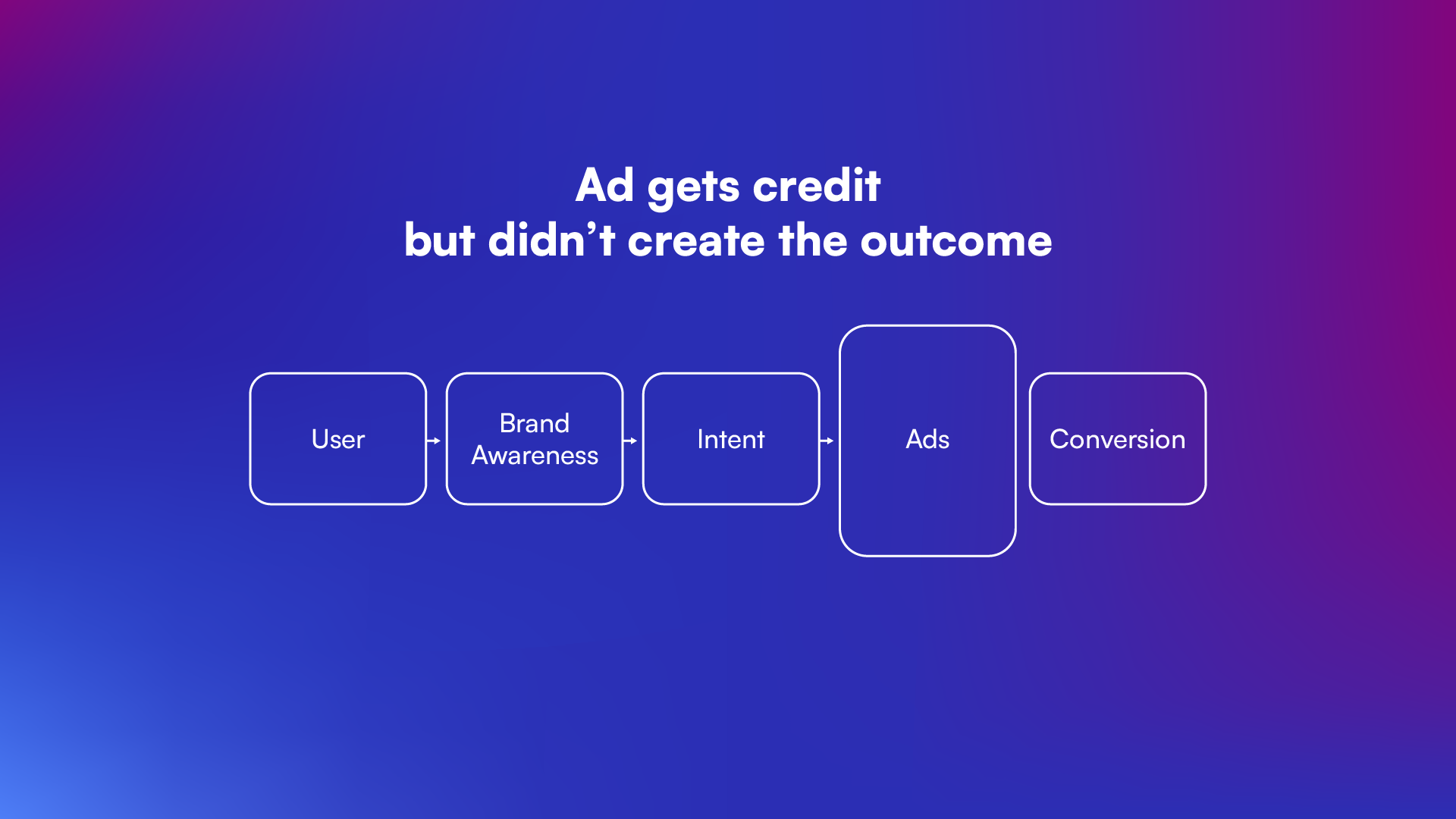
A user searches for your brand name, clicks your ad, and converts. Google Ads reports a conversion. But that user already knew your brand and already had purchase intent. The ad did not create that outcome, it intercepted it.
This is not a hypothetical scenario. For most mature brands, a significant portion of branded search conversions are non-incremental. The user would have navigated directly to your site, clicked an organic result, or found you through another channel. You paid for a conversion you were going to get for free.
Multiply that across thousands of clicks per day, and you start to see the real cost of measurement failure.
What Incrementality Actually Measures
Incrementality isolates the causal impact of your advertising. It answers one question: what would have happened if this ad had not been shown?
The gold standard methodology is a controlled experiment. You split your audience or geography into a test group (exposed to ads) and a holdout group (not exposed to ads). You measure the difference in conversion rates between the two groups. That difference is your incremental lift.
If the test group converts at 4.2% and the holdout converts at 3.8%, your incremental lift is 0.4 percentage points. That 0.4% represents the conversions your ad spending actually created. Everything else was going to happen regardless.
Building an Incrementality Testing Framework for Google Ads
Running valid incrementality tests on Google Ads requires structure. Here is what a rigorous framework looks like:
Geo-Based Holdout Testing
Google's own recommended approach for incrementality is geo-based testing. You select matched pairs of geographic regions, run ads in one set, and suppress ads in the other.
The key requirements for valid geo tests are clean market separation (minimal audience overlap between regions), sufficient sample size in each geography, matched baseline performance between test and control markets, and a test duration long enough to capture full conversion cycles. Typically this means a minimum of two to four weeks, though longer windows produce more statistically reliable results.
Google offers a native tool for this through their Ads platform, but the methodology is not exclusive to any tool. What matters is the rigor of your experimental design, not the software you use to execute it.
Conversion Lift Studies
Google provides Conversion Lift as a product-level incrementality measurement tool. It uses a randomized control trial framework where Google holds back ads from a randomized subset of users and compares conversion behavior between exposed and unexposed groups.
Conversion Lift studies are useful, but they come with constraints. You need meaningful spend levels to generate statistically significant results. The measurement window is fixed and may not align with your actual sales cycle, and the results are reported at an aggregate level, which limits the granularity of your optimization decisions.
Treat Conversion Lift as one input in your measurement stack, not the final word.
Where Google Ads Incrementality Typically Breaks Down
After running incrementality analyses across dozens of accounts, patterns emerge. Certain campaign types consistently overstate their value under standard attribution, and the gaps between attributed performance and incremental performance follow predictable fault lines.
Branded search is the most common offender. Incrementality lifts on branded search campaigns frequently fall between 10% and 50%, meaning that 50% to 90% of attributed conversions were non-incremental. For well-known brands, the incremental value of branded search is often close to zero. You are paying to cannibalize your own organic traffic.
Retargeting campaigns exhibit similar patterns. Users in your retargeting audiences have already demonstrated intent. Many of them will convert without seeing another ad. Incrementality tests on retargeting frequently reveal lift rates well below what ROAS metrics would suggest.
Broad match and Performance Max campaigns are harder to generalize because they operate across such wide targeting surfaces. But the opacity of these campaign types makes incrementality testing even more important. You cannot optimize what you cannot measure, and Google's automated campaign products deliberately limit your visibility into what is actually driving results.
Prospecting campaigns on Display and YouTube, conversely, tend to be undervalued by attribution models. These campaigns influence users early in the funnel and rarely receive last-click credit, but incrementality tests often reveal meaningful lift that attribution completely misses.
Setting Internal Standards for Incrementality
Here is what internal standards should look like:
Test cadence. Run incrementality tests on a rolling quarterly basis. Consumer behavior shifts seasonally, competitive dynamics change, and your media mix evolves. A test from six months ago may no longer reflect current conditions.
Minimum confidence thresholds. Establish a statistical significance standard before you run the test, not after. A 90% confidence interval is the floor for actionable decisions. For high-spend campaigns, target 95%.
Incremental CPA and incremental ROAS as primary KPIs. Once you have incrementality data, recalculate your cost per acquisition and return on ad spend using only incremental conversions. This is the number your budget decisions should be based on. If your attributed CPA is $40 but your incremental CPA is $120, you are operating on a fundamentally different economic reality than your dashboard suggests.
Documentation and institutional knowledge. Record every test, its methodology, its results, and its limitations. Incrementality measurement is cumulative. Each test builds on previous findings and informs future experimental design.
The Relationship Between Incrementality and Media Mix Modeling
Incrementality testing and media mix modeling (MMM) are complementary, not competing, approaches. Incrementality tests give you precise causal measurements for specific campaigns over defined time periods. MMM gives you a holistic view of how all channels interact and contribute to business outcomes over longer time horizons.
The most effective measurement frameworks use incrementality tests to calibrate and validate MMM outputs. If your MMM says branded search drives 20% of revenue but your incrementality test shows branded search lift of 15%, you have a calibration point that makes your entire model more accurate.
Neither method alone is sufficient. Used together, they provide a measurement system that is both rigorous and comprehensive.
What This Means for Your Google Ads Strategy
When you start measuring incrementality, your Google Ads strategy will completely change.
You will likely:
Reduce spend on branded search or shift it to organic capture strategies
Reallocate retargeting budgets toward prospecting
Demand more transparency from automated campaign types
Make budget decisions based on the actual value your advertising creates, not the value Google's attribution system assigns to it.
One should apply the same standard of evidence to your advertising that you would apply to any other business investment. If you spent $100,000 on equipment, you would want to know the actual return, not a modeled estimate provided by the company that sold you the equipment.
Incrementality measurement is that standard of evidence and how you move from hoping your ads work, to knowing which ones do.