Operationalizing Incrementality for Ecommerce Brands
· Tutorials/Guides
Punchline: The Study Is The Easy Part.
Every growth team has run a lift study. Almost no one has shortened the distance from study to bid. This entire piece is about encouraging you to build the operating system that closes the gap.
That gap is between a measurement program that produces clean numbers and a measurement program that changes what a media buyer does on a Tuesday morning.
The first gap has been closed across most of the DTC industry.
The second gap is wide open (live and operate here).
Most ecommerce brands at $50M to $500M have run an incrementality study in the last 6 months.
Many have run several and I always see the same results...
The studies sit in shared drives. The decks get presented quarterly.
The bid decisions still come off the platform-attributed number.
The good news
A decade of progress with very little to show for it on the ground.
The hardest part of incrementality is the operating loop around the results.
Measurement rigor in DTC has never been higher.
Geo holdouts, conversion lift studies, ghost bids, scaled MMM. Methodology has compounded.
The analysts running these studies are sharper than they have ever been.
The operators I know that are pulling ahead, are building full systems around the results.
Studies are easy to commission.
They are extraordinarily hard to operationalize.
But that's exactly where you need to focus.
Where measurement dies
Three failure modes most I see most growth teams hit.
The study ends. The market keeps moving. The decisions stop catching up.
01. The stale multiplier
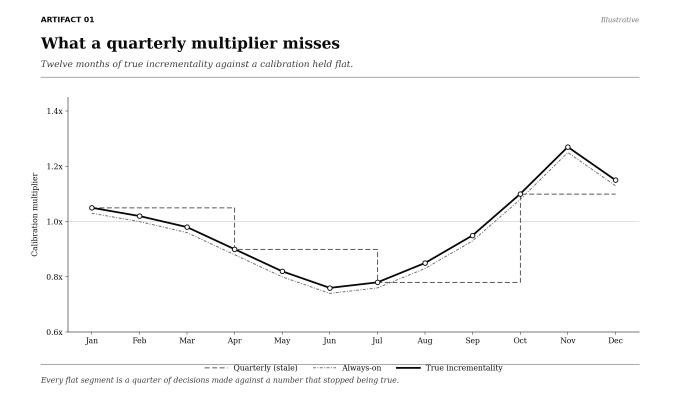
You ran a study in January. It is still in the same cell of the same spreadsheet six months later. CPMs climbed 40%. Creative fatigued. Promo windows came and went. The multiplier knew about none of it.
02. The shape problem
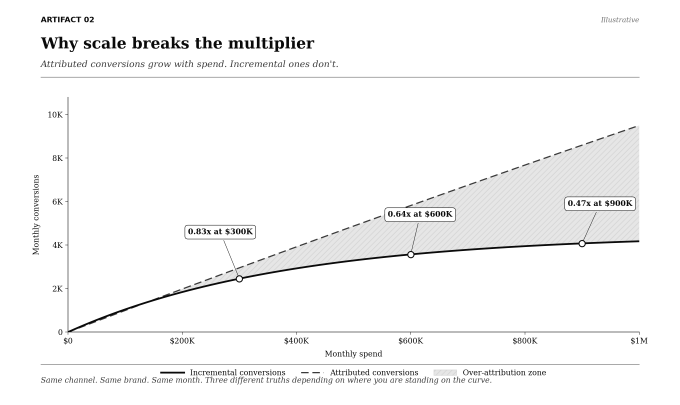
Even a fresh multiplier is wrong the moment you change spend. Every channel has a curve. A multiplier calculated at $300k/mo describes nothing about what is happening at $600k. The curve moved. The multiplier sat still.
03. The MTA trap
A beautiful attribution model fed raw platform-attributed conversions. Whatever over-attribution lives inside Meta and Google is baked in. The model confidently recommends the wrong allocation, every Monday.
Three failure modes.
One root cause.
The number stopped being true and nobody noticed.
But... you can fix that.
The foundation
We focus on four layers. Two sources of truth.
That gets you one number that touches every decision.
The architecture is simple. The discipline is the rare part.
Nothing in the stack is novel in isolation.
The novelty is running all of it as one system.
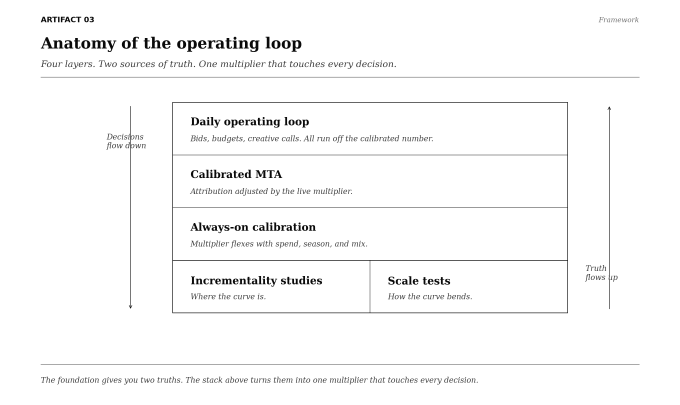
The foundation is two sources of ground truth. Point-in-time incrementality studies for the level. Scale tests for the shape. Run them on a cadence. Every output becomes an anchor, tagged with the conditions it was measured under.
Above the foundation sits an always-on calibration engine. A multiplier that flexes with spend, season, and mix, governed by the anchors below. The piece most brands are missing entirely. The study ends. The calibration keeps going.
Above that, attribution stops reporting raw platform conversions and starts reporting calibrated ones. The multiplier is folded in at the model layer, before it ever reaches the dashboard.
At the top, the daily operating loop. Bids. Budgets. Creative calls. Every decision runs off the calibrated number. The media buyer at 9am sees what the CFO sees at quarter end.
The numbers flow up. The decisions flow down.
The multiplier touches the bid!
Now... let's run through some scenarios:
Scenario one: The scale trap
Six figures. Single month.
A DTC supplement brand doubles Meta prospecting spend.
The multiplier does not cooperate. Brand blames the measurement provider.
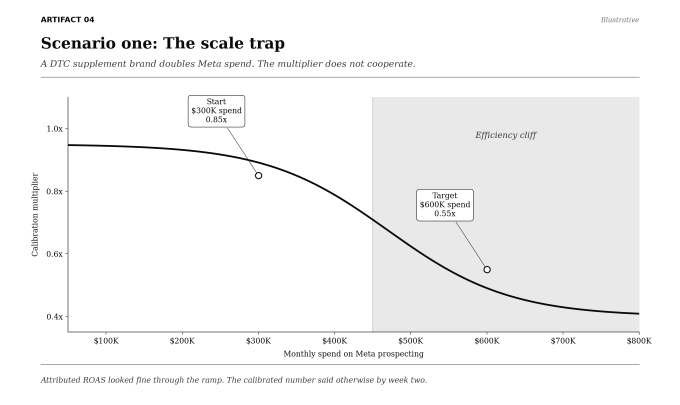
Without an operating loop around the studies, the team uses the January multiplier. Attributed results stay decent through the ramp. Reports go out. Everyone assumes scale worked. Three months later, contribution margin tells a different story.
With an operating loop in place, the scale test in the foundation showed the curve flattening past $450k. The always-on multiplier drops from 0.85 to 0.55 as spend crosses the threshold. Calibrated
MTA flags the efficiency collapse in week two. The team pulls back or shifts budget before the damage compounds.
Same brand. Same ramp. But now your decision changes in week two.
Scenario two: The seasonal miss
Q4 efficiency restored.
A home goods brand runs one study in July. Uses it through December.
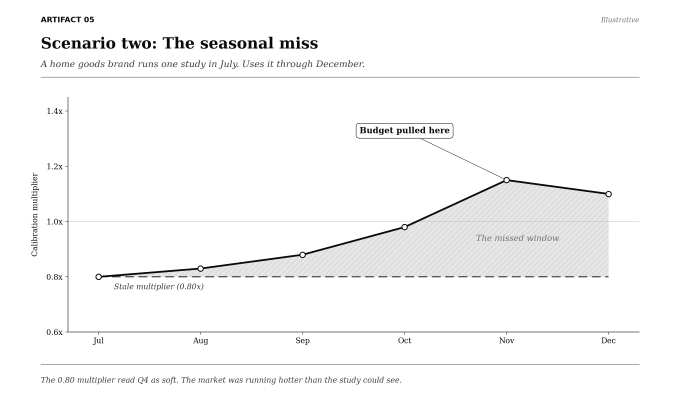
Without an operating loop, the team pulls paid social budget in December because the 0.80 multiplier makes Q4 look softer than the market actually is.
Real incrementality in Q4 is closer to 1.15. Fresh creative. Peak intent. A different auction entirely for this brand.
With the operating loop in place, the always-on layer flexes the multiplier up as the holiday curve moves. Budget flows to the highest calibrated contribution.
Efficiency holds. Top line grows.
A July study cannot read a December market.
Most brands ask it to anyway.
Don't be most brands.
Scenario three: The MTA trap
Same model. Different answer.
A fashion brand has a beautiful MTA model.
It drives weekly budget allocation.
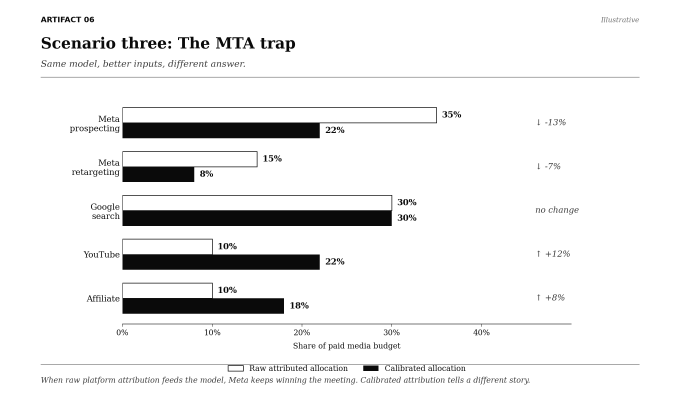
Without an operating loop, the MTA ingests raw platform-attributed conversions. Whatever over-attribution lives inside Meta and Google is baked in. The model confidently recommends shifting budget toward over-credited channels.
Meta prospecting and retargeting hold disproportionate share.
YouTube and affiliate get starved.
With an operating loop in place, the MTA sits above the calibration layer.
The numbers the model is weighing are already adjusted. Allocation follows incremental contribution. Same model. Better inputs. Different answer.
The inputs were the problem all along.
Prediction
The next decade of measurement work in ecommerce will be won on the plumbing between the study and the bid.
For the brands that we work with, we have an incredibly clean operating loop around the results and an exponential growth tool for always-on incrementality with our partner at Stella
You can choose any partner -- Haus, Measured, etc. Just build the loop and make it a goal to operationalize your measurement.
On our side: The multiplier ALWAYS touches the bid. The buyer at 9am sees what the CFO sees at quarter end. There is no two-deck reality.
Let everyone else keep running better studies into the same broken loop.
You should focus on operationalizing ahead of Q4.
If you need help operationalizing measurement for your brand, get in touch!